


How Historically Accurate Is the Original Stargate Movie? Myths, Facts, and Sci-Fi Wonder
- Aug 18, 2025
- 4 min read
A Deep Dive into Ancient Egypt and Hollywood’s Imagination
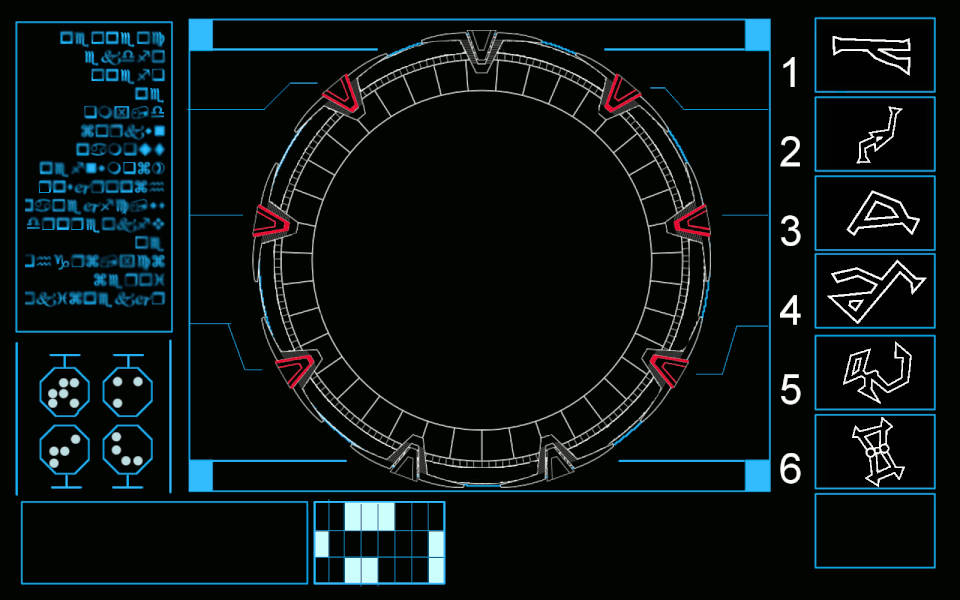
Stargate Dialing Computer by M.A.D company - CC By-SA 4.0 https://creativecommons.org/licenses/by-sa/4.0/
When most people ask me my inspiration for studying Archaeology, they assume I’ll reply with Indiana Jones or Lara Croft. However, what they don’t know is that had it not been for a glasses wearing, hay fever challenged Daniel Jackson – my love for the ancient world would have never been so large! If you’re anything like me, the moment you saw that massive ring whirl to life on the screen (even better if you were able to experience it in 1994!), you knew you were in for a wild ride. Roland Emmerich’s Stargate isn’t just a classic sci-fi adventure. It’s a film that weaves ancient Egyptian history with out-of-this-world speculation, starring Kurt Russell and James Spader. But just how much of what we see is historically accurate, and where does Hollywood take creative license? It’s time to open the gates (get it??!) to the journey that started it all.
Ancient Egypt… and Aliens?
The basic premise of Stargate is that the marvels of ancient Egypt - especially the pyramids - weren’t just the result of clever engineering, but of intervention by alien beings. In the movie, the alien “Ra” uses advanced technology to enslave humans and zip them across the cosmos via the Stargate. Tapping into the “ancient astronaut” theory made famous by books like Erich von Däniken’s Chariots of the Gods? and Zecharia Sitchin’s writings, the show has a playful take on an otherwise problematic conspiracy.
While these ideas make for fun stories – as much as I’d LOVE to be able to travel the universe - there is 0 proof of any kind of aliens helping build anything in Egypt.
The bottom line? Stargate’s core is pure sci-fi, not scientific consensus.
Where they got it RIGHT:
For a movie so heavily reliant on alien lore, it does make some efforts to ground itself in the real culture of Ancient Egypt. Egyptologist Stuart Tyson Smith was a consultant on the 94’ film, aiding to ensure that a level of accuracy was maintained.
Language: Dr. Daniel Jackson's love for ancient Egyptian languages stands out (it was one of the reasons I wanted to be an Egyptologist!). There's even some reconstructed Egyptian spoken in the movie, which is fascinating to see - even if the pronunciation could do with a bit more work….
Iconography & Costume: Visually, Stargate nails the Egyptian aesthetic - pyramids, hieroglyphs, ornate headdresses, gold, and lapis lazuli. These touches echo genuine Egyptian art and royal habits. However, their usage and what they represent is somewhat skewed, with dramatic effect clearly taking priority in these circumstances.
Social Hierarchy: The film does well to depict a personified version of the Sun God ruling over a stratified society: similarly in ancient Egypt, the pharaoh was seen as a bridge between gods and mortals. The presence of slaves in the film is still a key historical debate, though this element seems to be more of an amping up of drama for effect.
Where the Movie Goes Full-On Sci-Fy:
Let’s be honest - Stargate isn’t a documentary, and there will always need to be elements of drama and creativity to ensure the film does well.
The Pyramids as Alien Tech: The notion that pyramids were built as alien landing pads is pure fiction. Archaeology shows they were constructed by skilled workers over decades, not by otherworldly beings. As a child, I was waiting for the day 3 giant Pyramid shells came down from the sky and attempted to land on the Pyramids of Giza – talk about a parking nightmare!
The Stargate: There’s absolutely no record of any ancient Egyptian artifact resembling the Stargate. Though…. if you know something, or someone…. I am fully available to take on a secret mission that may or may not involve inter-galaxy travel.
Ra as an Alien Parasite: The sun god Ra was revered in Egyptian myth, but not as a tech-wielding parasite.
The Real Risks: Misconceptions and Myths
It’s important to remember that while Stargate is entertaining, it can perpetuate myths – the most notable being the idea that ancient peoples couldn’t achieve greatness without outside help. Egypt has spent many of the last few hundred years defending the idea that it was their own people that developed this great ancient civilisation, despite many western attempts to diminish this great feat. It is always encouraged to take creations like Stargate “with a grain of salt” and understand that it plays on an idea rather than a reality. Plus, Hollywood’s depictions often simplify the complexity of ancient society, which was much more diverse and dynamic than a simple tale of slavery and rebellion.
Stargate’s Lasting Legacy
Despite any historical inaccuracies, Stargate has had a huge impact on pop culture. It’s sparked TV spin-offs, comics, novels, and more, blending Egyptian myth with sci-fi adventure. If anything, it’s inspired new interest in Egyptology – and I am forever grateful it did, otherwise I wouldn’t have been as driven to study it at university over 20 years later!
Stargate is at its best when viewed as a bold blend of ancient history and sci-fi imagination. It mixes real mysteries with fantastic speculation about alien worlds and cosmic travel. So, while historians might wince at some of its liberties, there’s no denying its power to spark curiosity and wonder.
Have your own theories or favourite Stargate moments? Let’s keep exploring the mysteries - both real and imagined - that make stories like Stargate so irresistible.

Comments